
Social media users are finding that AI has “diluted” meaningful content and interactions
AI slop is causing some users to distance themselves from social media
Cynthia Jimenez Posted Dec.10, 2025.
From confusing videos of cats playing the bagpipes to photos of people with six fingers, generative Artificial Intelligence (AI) seems to have taken the internet by storm. In fact, as of earlier this year 71 per cent of images found on social media are AI-generated. Journalists at The Guardian found that one in 10 of the fastest growing YouTube channels globally are showing AI-generated content only. Where one used to find photos of friends and family sharing joyful moments one largely now finds AI slop.
“I used to use Instagram reels a lot more. I've pretty much completely given that up,” said Avnit Natt, a master’s student in Media, Medicine and Health at Harvard University in an online interview. Natt is a part of a small but growing number of people who are sick of the AI-generated slop they are seeing online.
AI Slop, as the name suggests, is low-quality AI-generated images, videos or text pretending to be human-made content. AI Slop is repetitive, inaccurate and easy to mass produce with generative AI tools like OpenAI’s Sora, KlingAI and Runway Gen 4.
Now with the prevalence of AI generated content and the integration of AI chatbots on social media, such as Meta’s AI , some companies like DataForest suggest AI generated content can enhance users' experience through personalization of content. The 2026 Industry Pulse Report also found 63 per cent of media experts are “eager to embrace AI-driven opportunities.”
However, a flurry of online articles and essays suggests many users believe AI is hindering their experience rather than enhancing it.
“I am thoroughly sick of the amount of AI Slop I see,” said Natt.
“I don't care for looking at my For You Page, I don't even check it. I used to go check people's stories every day, check people's posts, I don't even do that anymore,” shared Marian Farra, a fifth-year astrophysics student at McMaster University in an online interview.
The question now becomes whether AI Slop will repel users from social media or pull them further into the online world?
AI, Authenticity and Actuality
When it comes to AI Slop, “many studies cite a decrease in perceived ‘authenticity’” wrote Lou Millar-MacHugh, a UX designer and technologist in an emailed statement. They shared that currently a lot of the discussion surrounding AI on social media are its psychological effects.
“[AI generation] takes away the integrity and the creativity and the individuality from the creative process,” said Imaan Mitha a pharmacy technician assistant who also has reduced her social media usage due to AI Slop.
Previously, Mitha used social media platforms such as Pinterest and Tik Tok to find inspiration from other dancers and choreographers.
But even with what can be described as personalised content on Mitha’s feed, she shared, “I don't feel inspired anymore when I'm on social media or online.”
According to Allan MacDonald a UX researcher, “no one is asking for more of [AI generated content] , in fact they’re asking for less.”
In MacDonald’s recent essay,The internet needs an AI off switch, he suggests platforms need to give users the ability to reduce or remove-AI generated content to keep their engagement up.
In 2024, Instagram and TikTok began labelling AI-generated content on their platforms. YouTube required creators to disclose when “realistic content… is made with altered or synthetic media, including generative AI.” Pinterest announced in October a tuner which would allow users to see less AI generated images in certain categories.
Still, these disclosure measures do not stop AI-generated content from being posted online and prevent them from appearing on people's feeds.
“If I see any accounts that post AI-generated art, my automatic reaction is just to block that sort of content because I don't want that content coming up in my feed” expressed Mitha in frustration.
Ben Moore the US Managing Director of BeReal, in a LinkedIn post from last month, claimed “BeReal has officially become the only social app with no AI-generated content at all.”
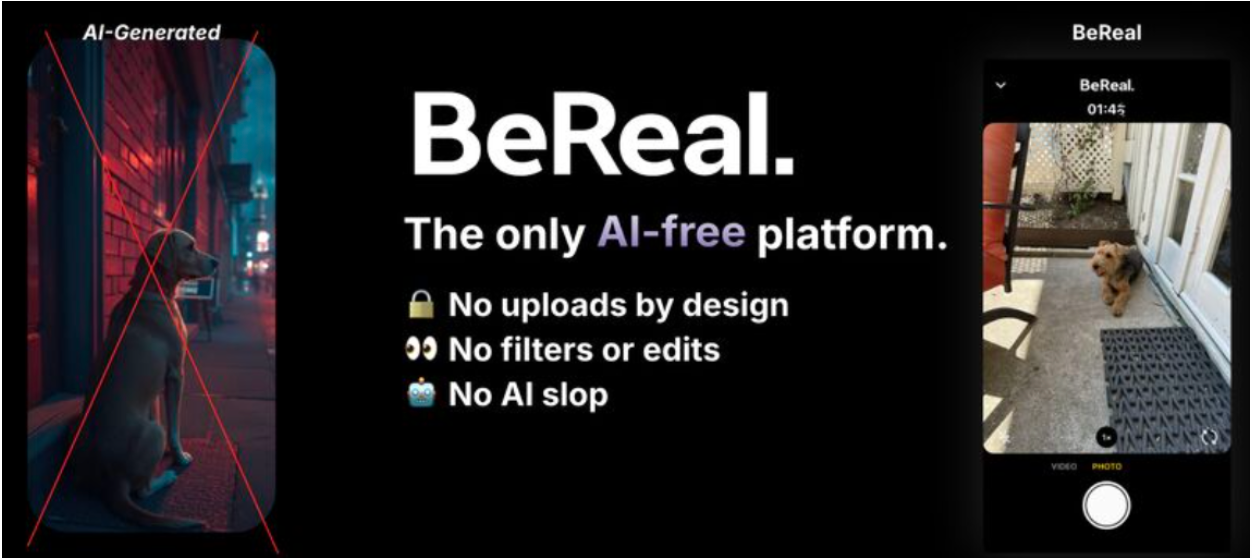
He wrote that on BeReal there is “ No AI replacing any human. Just real people, sharing real moments, in real time.”
However, Millar-MacHugh also cautions that even though a decreased perception in “authenticity” was noted in various studies concerning AI, what is meant by “authenticity” often isn’t explained. “Authenticity is a highly debated term and can be said to function as a form of cultural capital, and its definition might privilege certain forms of expression over others.”
A move towards being offline
For some, it has come to the point where the idea of no social media sounds a lot better than an AI social media.
Natt shared she has considered leaving social media entirely, but felt she wouldn’t be able to because social media is often how she stays connected both with friends and the news cycle.
“Either I give up having to look at any of the [AI-generated content], and it's kind of that burden off my chest, or, I miss out on knowing what's happening in the world around me,” said Natt.
Statistics Canda in a 2020 survey found the Internet was the most common method for following news and current affairs.
Scott Martin a freelance journalist and founder of The Catch, expressed a similar inability to leave social media due to other considerations. “I am very jealous of people who can just detach from all social media, because if I didn't need to promote my work, I would have done it. I would have done it years ago” said Martin in an online interview.
According to a survey conducted by the Pew Research Center in 2022, 90 per cent of journalists in the United States use social media for their jobs.
The need to stay connected socially is another factor some noted as a reason to stay online, even if they are fed up with AI Slop.
“I would say definitely I don't interact as much as I do with people on Instagram, especially anymore,” said Farra, who missed a scheduled interview with a reporter because she had not been on Instagram that day.
“It’s just the convenience of needing to talk to people, and that's the only way that they can reach out to me.”
An AI free online space
As MacDonald suggested in his article, “people want the human internet back.”
A new internet extension called SlopEvader, created by artist and engineer Tega Brain, lets users browse the internet as if it was November 29, 2022: before the first public release of ChatGPT. The extension’s overview says it “offers some respite. If you want to browse the web before the age of generated media, this tool is for you.”
While SlopEvader acts more as a piece of performance art rather than a practical tool for navigating the internet, its existence makes it clear people are tired of being flooded by AI Slop while online.
iHeartMedia also recently announced its “Guaranteed Human” campaign, which will not allow AI generated content on-air, including music. In a study conducted by iHeartMedia they found nine in 10 of their consumers believed knowing their media is created by a real person, as opposed to AI, was important.
Andrew Yeung, a New York based technology investor who previously worked for Google in a recent LinkedIn post commented on the current and future state of social media.
“The next massive social platform will have no AI.”
“No AI avatars, no AI-generated audio, no AI slop. It'll take us back to the era when social media was at its cultural peak.” wrote Yeung and it seems he could be right.
Just last month, beloved short-form video app Vine announced they would be relaunching as diVine. According to their website diVine would be a “sanctuary for authentic human creativity.” diVine will not allow AI-generated content on the site.
The app would not only have an anti-AI content policy but would also employ the use of ProofMode, which would cryptographically “notarise” videos for authenticity.
Even with speculations of a trend towards human-centred content and platforms promising AI-free spaces, there is little accountability. Currently, Canada has no regulatory framework specific to AI.
“One of the things that really sucks about modern life is that we're really at the whims of these platforms,” said Martin.
Natt said as she continues to distance herself from social media, she often has to rely on her own intuition to decipher from human-made and AI generated content.
Uncertain about what her social and digital life will look like due to AI, she shared, “as of right now, it's like the deep gut feeling that almost tells you, ‘Oh, a human did not make that’ but I don't know how long I'll be able to tell.”